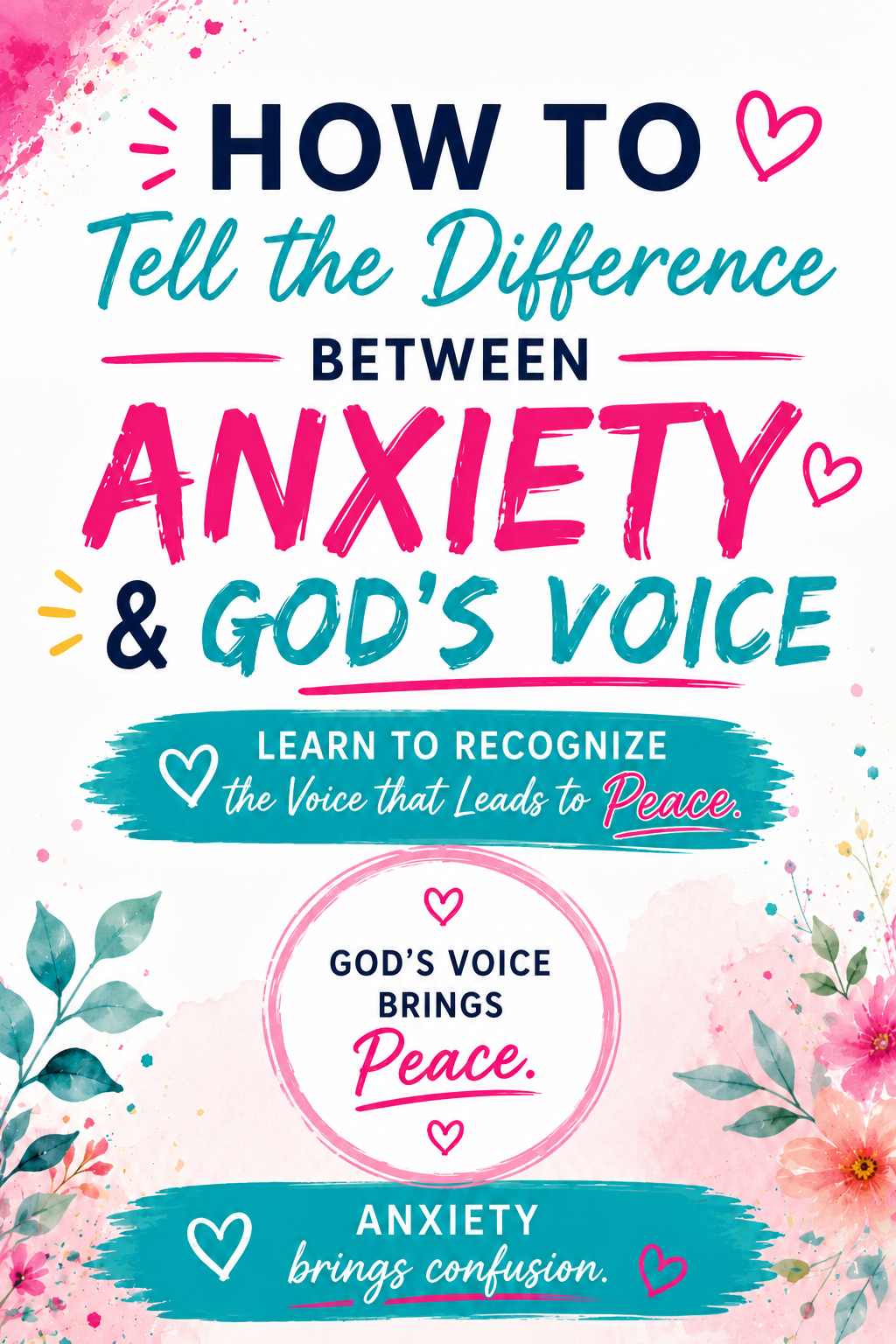
How to Tell the Difference Between Anxiety and God's Voice
If you've ever laid awake at night wondering whether a thought came from God or from anxiety, you're not alone. I spent years confusing the two. I would feel a sudden sense of fear about my children, my future, my marriage, or a decision I needed to make, and then I would wonder, "Is God trying to warn me?" The thought felt important, urgent, and impossible to ignore. So I would replay it over and over in my mind, trying to figure out whether it was God's voice leading me or anxiety pulling me into another spiral of overthinking. Maybe you've been there too.
The truth that changed everything for me was this: God's voice produces clarity, while anxiety produces confusion. One draws us closer to Him, while the other keeps us trapped in fear. The problem is that anxiety often disguises itself as wisdom. It convinces us that worrying is being responsible, that overthinking is preparation, and that fear is discernment. But when we look at Scripture, we find a very different picture of how God speaks to His children.
Anxiety Speaks in Fear
Anxiety is loud. It is demanding, and it screams for immediate attention. It fills our minds with endless "what if" scenarios: What if something happens to your child? What if you make the wrong decision? What if you fail? What if God doesn't come through? Anxiety rarely presents just one thought—it presents hundreds. It creates mental chaos, and instead of leading us toward trust, it pushes us toward control. I know because I lived there for years. I believed that if I could just think through every possible outcome, I could somehow protect the people I loved. But all that overthinking never produced peace; it only produced exhaustion.
Anxiety tells us that if we worry enough, we'll be safe. God tells us that safety is found in Him. Isaiah 26:3 says, "You will keep in perfect peace those whose minds are steadfast, because they trust in You." Notice that peace comes from trust, not from figuring everything out. The world tells us to gain peace by controlling our circumstances, but God invites us to experience peace by trusting His character. The more we try to control what only God can carry, the more anxious we become. True peace begins when we surrender our fears and place our confidence in the One who already holds the future.
God's Voice Leads with Peace
Many people assume that God's voice always comes with dramatic signs, supernatural experiences, or some unmistakable moment of divine revelation. Sometimes it does. But more often, God speaks through His Word, His Spirit, and a quiet conviction in our hearts. God's voice may challenge you, call you to obedience, or stretch your faith in ways that feel uncomfortable. However, it will never manipulate you through fear. The Holy Spirit convicts, while anxiety condemns. The Holy Spirit guides, while anxiety pressures. The Holy Spirit brings clarity, while anxiety creates confusion.
One of the simplest ways to recognize the difference is to look at the fruit each voice produces. God's voice leads us toward trust, peace, and dependence on Him. Anxiety leads us toward fear, panic, and a desperate need for control. God is not the author of panic; He is the Prince of Peace. Even when God corrects us, His correction is rooted in love, not fear. He doesn't shame us into obedience or threaten us into surrender. Instead, He lovingly invites us to trust Him more deeply, knowing that His plans for us are good and His heart toward us is always faithful.
How Jesus Responded to Fear
One of my favorite examples of faith over fear is found in the story of Jesus and His disciples during a storm. The waves were crashing, the wind was howling, and the disciples were terrified. As water filled the boat and panic spread among them, they were convinced they were about to die. But where was Jesus? Sleeping. The disciples saw a storm, but Jesus saw an opportunity to trust His Father. The circumstances were real. The danger was real. Yet fear was not leading Jesus—faith was.
I think many of us can relate to the disciples. We see the storms raging around us and immediately begin imagining the worst-case scenario. Anxiety becomes the loudest voice in the room, convincing us that panic is the appropriate response. But Jesus responded differently. He wasn't ignoring reality; He simply viewed reality through the lens of God's sovereignty instead of fear. In the same way, Jesus invites us to look at our circumstances through the lens of faith. The storm may be real, but so is the God who is with us in the middle of it. When we learn to focus more on the One in the boat than the waves around us, fear begins to lose its power and peace begins to take its place.
Four Questions to Ask Yourself
The next time you're unsure whether a thought comes from God or anxiety, ask yourself these questions.
1. Does this thought produce peace or panic?
God may call you to difficult things, but His voice will not drive you into panic.
Anxiety creates urgency.
God creates peace.
2. Does this align with Scripture?
God will never tell you something that contradicts His Word.
This is why spending time in Scripture is so important.
The more familiar you become with God's character, the easier it becomes to recognize His voice.
Jesus said: "My sheep hear My voice, and I know them, and they follow Me." (John 10:27)
We learn His voice by spending time with Him.
3. Is this thought pulling me toward trust or control?
Anxiety always wants control.
It wants guarantees.
It wants certainty.
God asks for trust.
If a thought is causing you to grip tighter and tighter, it may not be from Him.
4. Would a loving Father speak this way?
This question has helped me tremendously.
God is a perfect Father.
Would He shame you?
Would He mock you? Would He constantly tell you that you're failing?
Of course not.
God speaks truth, but He speaks it through love.
A Simple Practice for Discernment
When anxious thoughts begin racing through your mind, try this simple exercise. First, write the thought down. Getting it out of your head and onto paper often helps you see it more clearly. Then ask yourself two important questions: Is this fear or faith? Is this God's truth or my anxiety's prediction? Anxiety tends to make assumptions about the future, while God's truth anchors us in what is already certain about His character.
After identifying the fear, find a Scripture that speaks directly to it. If you're afraid of the future, look for verses about God's faithfulness. If you're worried about making the wrong decision, find passages about God's guidance. Then intentionally replace the lie with God's truth. This isn't about denying reality or pretending your concerns don't exist. It's about choosing to view reality from God's perspective rather than anxiety's. Over time, this practice helps retrain your mind to recognize truth more quickly and fear less often. The battle against anxiety is rarely won all at once—it is usually won one thought at a time as we continually choose to believe what God says over what fear is shouting.
Final Thoughts
Anxiety will always try to sound convincing. It will demand your attention and whisper that one more round of overthinking will finally bring the peace you're looking for. But if you've struggled with anxiety for any length of time, you already know that overthinking never delivers on that promise. It only creates more questions, more fear, and more exhaustion. True peace is not found in perfect understanding. It is found in perfect trust.
The more time you spend with God—reading His Word, learning His character, and growing in relationship with Him—the easier it becomes to recognize the difference between His voice and anxiety's lies. One voice leads to fear, confusion, and the need to control every outcome. The other leads to freedom, trust, and rest. One keeps you focused on everything that could go wrong. The other reminds you of the God who holds everything together.
Friend, choose the voice that sounds like your Shepherd. Jesus said that His sheep know His voice, and His voice will never leave you trapped in fear. It will never shame you, condemn you, or push you into panic. Instead, His voice will always lead you toward peace, because that is the heart of the One who loves you most. When anxiety gets loud, remember that the voice of Jesus is still speaking—and His truth is always greater than your fear.
Ready to Break Free from Anxiety's Lies?
If this message resonated with you, my upcoming book, Satan, the Ultimate Mean Girl, goes even deeper into the subtle lies anxiety whispers and the biblical truths that expose them.
In this book, you'll discover how the enemy uses fear, shame, overthinking, perfectionism, and insecurity to keep women stuck—and how God's truth can set you free.
Through personal stories, practical tools, and Scripture-based encouragement, you'll learn how to recognize anxiety's voice, replace lies with truth, and walk confidently in the peace God intended for you.
Pre-order your copy today and receive the exclusive 5-Day Bible Study PDF, "The Lies Anxiety Tells," as a free bonus.
Because anxiety doesn't get the final word.
God's truth does.